

Glow events live and die by the physics of fluorescence and phosphorescence. The fact that fluorescent and phosphorescent materials emit light depends on them containing optical brighteners, and that objects that glow in the dark need to be ‘charged’ before they start to glow, are two of the biggest let-downs for glow parties. This is usually something that has gone wrong in the planning spreadsheet, and not the decoration budget.
Getting the ultraviolet output right
The largest mistake when choosing blacklights for a glow party is treating all blacklights (even those marketed as UV lamps) as if they were all the same. A typical household fluorescent tube produces a very broad output with a significant amount of visible violet. To get good fluorescence from materials containing optical brighteners, one needs a narrow band of ultraviolet output, which is best provided by a UV-A LED, centered near 365 to 395 nanometers. Because so little of the light from a UV-A LED is seen by the eye as source light, the fluorescent materials in the room will appear to ‘glow’ sharply and with good contrast.
Instead of maximum wattage, prioritize coverage. Four average brightness blacklights strategically placed around the perimeter of a room at head height and aimed inwards will generally outperform two very powerful blacklights positioned in opposite corners of a room. Also important is to try to eliminate all the dark shadowy areas in the room where people will stop glowing.
Controlling ambient light
Don’t underestimate the power of main venue lights even when switched off. Identify any safety signage such as emergency exit signs and corresponding lighting for the bar area and the kitchen. All such lighting is hard wired and cannot be switched off. Conversely the lighting used by staff and providers for task work can be switched off and should be covered with red filter cloth to prevent wash out of glow materials.
Decoration choices that actually fluoresce
Test it before you buy it for a glow event. Test fabrics for their different fluorescent dyes. As an example a medium gray fluorescent fabric from two different suppliers can look very different. Build a test kit of all the different products you have found and take a handheld UV flashlight to suppliers to test the fabric on the roll before you buy it all. Keep a note of which ones perform well.
- Fluorescent gaffer tape and chalk markers give the strongest, most reliable response and cost very little per square meter of effect.
- White cotton and polyester with optical brighteners glow well, which makes plain white linens and drapes an efficient base layer.
- Tonic water and certain highlighter inks fluoresce strongly, useful for bar displays, though keep ink well away from anything consumable.
- Phosphorescent paint and vinyl need five to fifteen minutes under bright light to charge, then fade over twenty to forty minutes, so position them where house lighting reaches during setup.
Layering depth into the space
Neon printed on flat surfaces can look cheap when photographed. Create suspension of fluorescent cord or ribbons at varying heights and use mesh and netting to create glows at varying depths. Leave some dark negative space between objects and avoid covering all surfaces with decoration.
Accessories that turn guests into the lighting
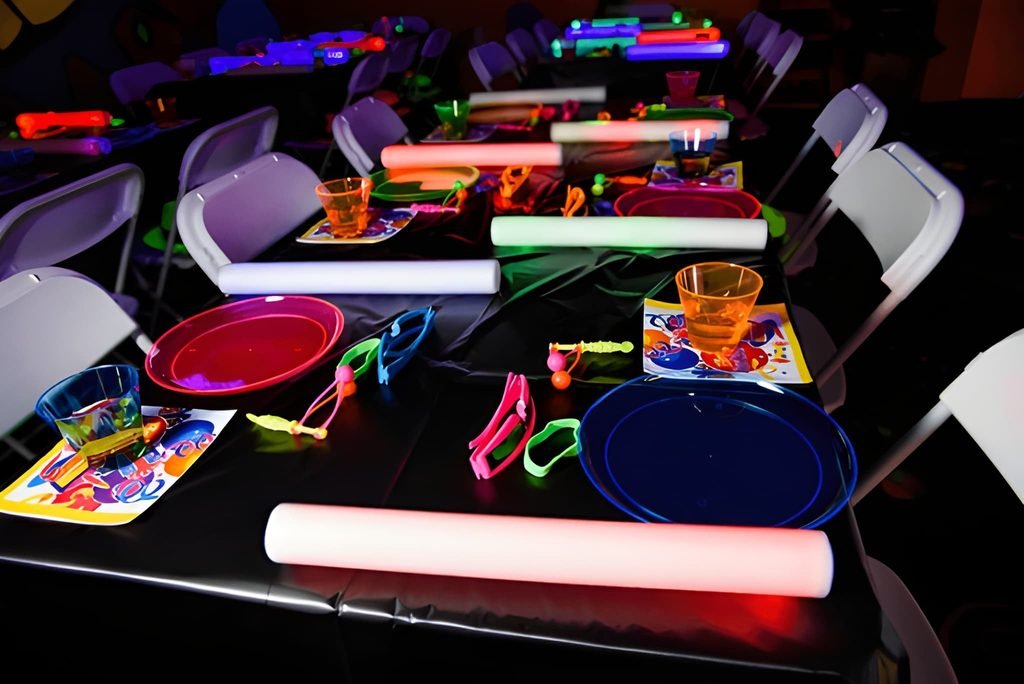
The most efficient decoration for a glow party is the crowd. All you need is 200 or so guests wearing light-up things like bracelets, wands, glasses or a number of different types of LED badges. Buying a complete spread of glow party supplies in bulk is the surest way to get light distributed all over the floor of your party space, rather than concentrated on a stage.
You have a number of choices when it comes to offering glow for your partygoers, chemical glow sticks or battery-powered LED items. These have very different ‘operational characteristics’ so you should decide on the type of glow you’re going to offer early on.
| Factor | Chemical glow sticks | LED accessories |
| Duration | Four to eight hours, fading steadily | Eight to twenty hours at constant brightness |
| Unit cost | Lowest, suited to high-volume giveaways | Higher, better as ticketed extras or VIP items |
| Activation | Instant, no setup, single use | Switch or pull-tab, reusable across events |
| Risk | Leak and staining potential, not for under-threes | Button cell batteries require strict child safety controls |
| Disposal | General waste, no recovery value | Battery waste stream, stock recoverable |
Distribution timing
Instead of stocking lots of items and letting them wander off before the party, hand out items at the entrance to the space, staffed by someone in charge (e.g. That friend who set up the glow). This creates a clear point of entry to the dark space, stops supplies from walking, provides a clear transition point to your guests and means you can control how many items each guest takes.
Games built around low visibility
Don’t fight the dark. Activities like a ring toss with neon lit posts, a treasure hunt with UV-ink printed clues that can only be read with a handheld UV flashlight, or even a limbo pole with neon tape all work really well because in the dark the only thing that you can see is the target.
Differently colored bands ensure players can be easily distinguished and allow for capture games to be played by teams at larger events. Such games can be explained with only a single sentence for each rule to ensure that written explanations can be read by players within the dark space.
Safety under reduced vision
Use fluorescent tape to clearly mark out step edges, door frames, and runs of cable around the venue. Walk the route after dark with the house lights off and appoint stewards to direct guests where necessary i.e. Down steps, at changes of level and at bars serving queues of guests.Read more at https://activepropertycare.us/.