

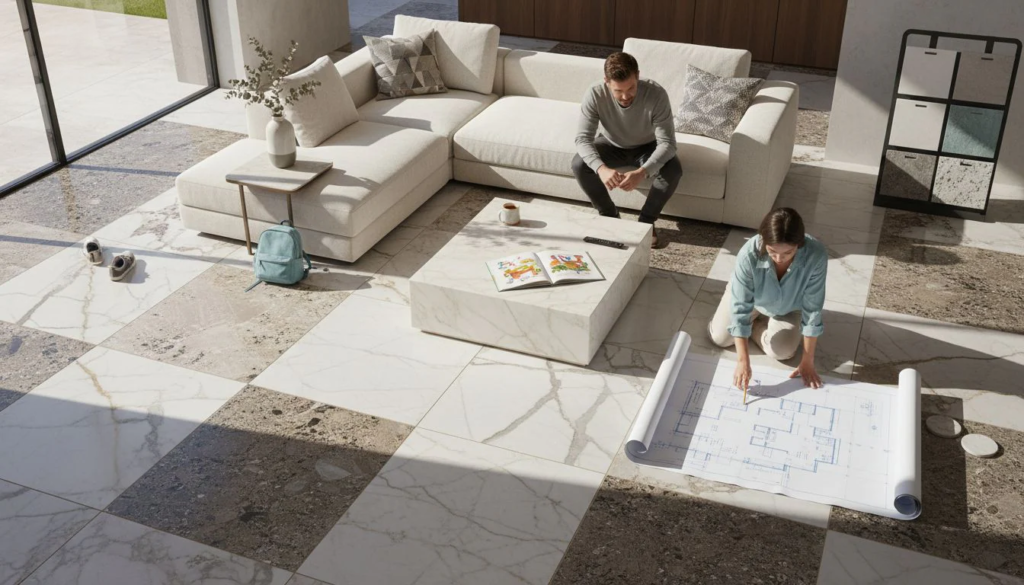
Creating a cohesive interior space often relies a great deal on how well different material choices interact with one another. Stone, tile, and fixtures each carry their own visual weight, texture, and tone, and when combined intentionally, they can transform a room from ordinary to elevated. The challenge isn’t just selecting beautiful individual elements, but ensuring they work together to form a unified design.
Building a Cohesive Material Foundation in Interior Design
Successful interior design often starts with selecting one dominant material that can be built upon to create a cohesive space. In kitchens and bathrooms, stone is a popular foundational choice because it establishes tone, movement, and visual weight. Once the anchor is chosen, it is important to find tile and fixtures that support that central material.
A cohesive approach usually depends on limiting the number of competing elements, so designers typically follow a simple structure:
- One dominant surface material
- One supporting tile style
- One or two fixture finishes
This moderation allows for variation in texture and tone without overwhelming a space.
Balancing Texture, Tone, and Visual Weight
The most effective interiors rely more on contrasting textures rather than colors. Polished stone can be paired with matte ceramic tile to create subtle depth, while brushed or satin fixtures soften transitions between surfaces. When everything is glossy or highly reflective, a space can feel too busy, whereas using a combination of glossy and matte can provide better balance.
Tone selection also plays a major role. Warm stones and tiles in beige or golden tones tend to pair well with brass or bronze fixtures, while cooler ones in shades of gray or white often go better with chrome or black finishes. However, exact matching is less important than maintaining balance across the overall palette.
Using Fixtures as a Unifying Design Element
Fixtures act as connectors of sorts between materials, so their finishes should be repeated thoughtfully throughout the space to avoid a disjointed appearance. Even small inconsistencies – such as mixing three different metal tones – can disrupt the visual flow.
To maintain a cohesive look, designers often:
- Repeat fixture finishes in at least two locations
- Match undertones (warm vs cool metals)
- Limit accent finishes to one per space
When done well, fixtures are the subtle thread that tie stone and tile together.
Creating Depth Through Material Contrast
Mixing stone, tile, and fixtures is ultimately about creating depth without chaos. A well-designed room feels intentional because each material has a specific role. For designers exploring material combinations, using room creators with material customization can help with visualizing how different elements will interact before making final selections.
Designing Spaces with Material Intent
The most enduring designs are not built on individual statement pieces, but on the relationship between the various materials. When stone, tile, and fixtures are selected intentionally as part of a unified whole, the result is a space that feels deliberate, balanced, and visually appealing even when multiple textures are present. Cohesion doesn’t mean everything matches perfectly – it means that each material has a purpose within the overall design.
